Watchman
Mariners' Museum, Uncurated Search Results
Type: Bugeye
Year: 1872
Builder:
Location: Crisfield

These records are found in the online catalog of The Mariners’ Museum and Park in Newport News, Virginia. Uncurated search results are presented to give researchers and interested readers an idea of whether the museum’s archives contain information about this vessel and whether it may be worthwhile to visit the museum’s catalog search page for further investigation. Uncurated results may be inaccurate or incomplete.
Search mode: Exact Name. Search phrase(s): "Watchman". Results returned: 10. Results displayed in this table: 10.
Use these buttons to send uncurated search results to your own app or text document for further research. First, check the box for any row, or click "Select All" then uncheck any rows. Then click "Show Selections". You can then copy your selections from the text box and past them into your app.
| Fetch? | Row ID | Media | Date | Vessel | Place | Related Places | Inscription/Marks | Subject | Notes | Archive Number |
|---|---|---|---|---|---|---|---|---|---|---|
| 1 | 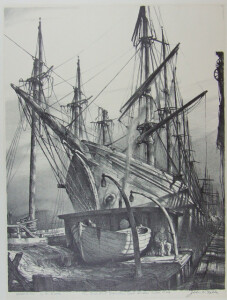 | NOTES: Two duplicate copies of the print deaccessioned on 4/27/78. NOTES: Port Johnson is on the north shore of Kill Van Kull, of the city of Bayonne, New Jersey. LABEL COPY: WATCHMAN OF THE DEAD John A. Noble (american, contemporary) Lithograph on Paper LP 6138 | CL9910 | |||||||
| 2 | 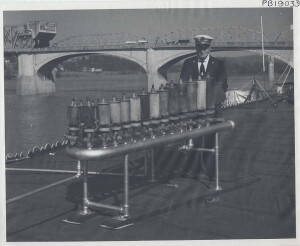 | 1959/03/24 | WRITTEN ON VERSO: BUILT 1914, AT PITTSBURGH. OWNED BY STEAMER AVALON, 260T, 157.5 X 46 X 5 | Watchman, Harold Donaldson, stands behind the steam calliope on board the steamboat, AVALON. Alternate Name: Idlewild | P0001.003/01-#PB19033 | |||||
| 3 | 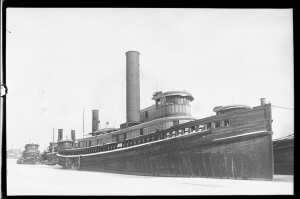 | 2/2/1939 | Cornell Steamboat Company.; H. D. Mould (Steamboat : 1896).; William S. Earl (Screw steamer : 1859).; W. N. Bavier (Steamboat : 1901).; Hercules (Steamboat : 1876).; Watchman (Steamboat : 1898). | Rondout Creek (N.Y.). | Cornell Steamboat Company, Rondout, New York (Feb. 2, 1939); tugs: "H. D. Mould" 1896, "William S. Earl" 1859, "W. N. Bavier" 1901, "Hercules" 1876, "Watchman" | Tugboats laid up at dock. | MS0091/03.01-16#032 | |||
| 4 | No image URL. | Lexington (Steamboat : 1835)–Fire, 1840 | Cover [i.e., p. 1] has poem titled: Loss of the Lexington; taken from the Christian Watchman. | LB27465 | ||||||
| 5 | No image URL. | Ranvik (Steamship : 1929). | Whaling.; Sailors. | This group of small snapshots feature daily activities on the Norwegian whaling ship Ranvik during the 1930s. Images include casual portraits, at work in foul weather gear; whales alongside the ship; deck scenes. __The prints were collected by the donor's father when he worked as a night watchman on the New Orleans, Louisiana waterfront. The photographs are of the crew on the Norwegian whaling ship Ranvik. When the ship came into port, one of the crewmembers asked Mr. Schmidt about getting the film developed. It is believed that Schmidt made an additional set of prints for himself. | MS0845 | |||||
| 6 | No image URL. | SHORT DESCRIPTION: Wood engraving titled 'A Whaling Station on the California Coast' published on the cover of the June 23, 1877 edition of Harper's Weekly, Vol. XXI, No. 1069. The artist is Paul Frenzeny. The image shows the manner in which the work of cutting up the captured whales is carried on. Round inset image at upper left shows a man leaning against a signal flag pole while keeping watch for whales. The remainder of the print shows a whale carcass just off the shore line, men cutting up the whale and carrying the blubber ashore, and a building where the blubber is being cooked down. The sky is filled with seagulls and the smoke from the two chimneys on top the building. NOTES: The print shows shore whalers in California who hunted for whales in small boats near the shoreline, directed by a watchman onshore. Once they captured a whale the crews brought it back to shore to be processed, rather than processing it at sea like traditional whalers. The text supporting the article states: A WHALING STATION. Here and there along the coast of California may be found whaling stations, established chiefly by Portuguese or Sandwich Islanders. Our first page engraving shows the general character of these stations, and the manner in which the work of cutting up the captured whales is carried on. Watch is carefully kept from an elevated look-out, and the raising of a flag is the signal to the fishermen on the beach that whales are in sight. The men instantly take to their boats and give chase to their prey. Harpoon guns and explo sive bombs are used to dispatch the whale as soon as the boats get within striking distance, and the body is then secured and towed ashore, where the blubber is stripped off. It is tried out over ovens similar to those shown in the engraving, and the oil collected in casks for shipping. The whale most commonly taken in this manner is known as the "gray-back." A large one some-times yields a profit of several hundred dollars. NOTES: Nantucket native William F. Macy learned the printer’s trade at Nantucket’s newspaper, ‘The Inquirer and Mirror.’ After going to the mainland he worked in several printing shops around Boston and was appointed as the first instructor in printing at the Lyman School for Boys in Westboro, Massachusetts. Later Macy opened an insurance agency in Boston. Throughout this time he continued studying Nantucket history and frequently contributed articles to ‘The Inquirer and Mirror’ (signing his articles "Yorick"). Around 1912, in collaboration with Anna Gardner Fish and Roland Bunker Hussey, Macy issued the first edition of the "Nantucket Scrap Basket". He arranged for a second edition of this publication in 1932. In 1915, Mr. Macy prepared and published "The Story of Old Nantucket," a condensed history of Nantucket (reprinted in 1931). He was a founder and one time president of "The Sons and Daughters of Nantucket." In 1924, Macy was appointed President of the Nantucket Historical Association and served until his death in 1935. During this time Edward F. Sanderson approached the Association about receiving his collection of whaling paraphernalia with the purpose of establishing a whaling museum on Nantucket. When he returned to Nantucket in 1928 Mr. Macy purchased the old American House property, on the corner of Orange Street and Martins Lane, and built the house now standing there. This became Macy’s headquarters during his decade of planning, raising money and finally establishing the Nantucket Whaling Museum which opened its doors on July 24, 1930. | CL442 | |||||||
| 7 | 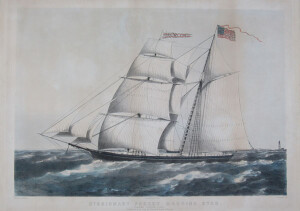 | NOTES: The Boston Evening Transcript, January 2, 1857, page 4 states that ‘C. Drew, 18 Court Street, has just published a beautiful tinted lithograph print of the “Morning Star” as she appeared while passing Boston Light under full sail. The sketch is a spirited one, and should at least be possessed by each contributor to the fund which purchased the vessel.' The Morning Star sailed on December 2 and would have passed Boston Light on that day. NOTES: Notes from Bulletin of the Museum of Comparative Zoology, Volume 163, number 1, March 23, 2021, "In order to Study Conchology": Andrew Garrett (1823-1887) and his 1859 Expedition to the Kingsmill Islands (Kiribati), by Theodore W. Pietsch and Alan R. Kabat, page 13: The Morning Star was the first of five missionary vessels of that name. The Morning Star was built at Chelsea, Massachusetts, by the American Board of Commissioners for Foreign Missions to aid in mission work in Hawai‘i, Micronesia, and the Marquesas Islands. In August 1856, in response to a request from the Board of the Hawaiian Evangelical Association, the American Board appealed to children in the United States to help purchase a missionary packet by buying 10-cent shares of ownership. In return, the children received Certificates of Contribution. One hundred and twenty thousand American children became stockholders, and by year’s end the Morning Star, a hermaphrodite brig (square-rigged foremast and fore-and-aft mainmast), had been built in Chelsea, Massachusetts, at a cost of $18,351. Launched on 12 November 1856, she sailed from Boston on 2 December 1856, under the command of Captain Samuel G. Moore, and arrived at Honolulu on 24 April 1857. She continued to sail between South Pacific missions until she was sold in 1866. VESSEL INFORMATION-- VESSEL NAME: MORNING STAR VESSEL TYPE: HERMAPHRODITE BRIG SHIPBUILDER: JOTHAM A. STETSON SHIPBUILDER LOCATION: Massachusetts, Chelsea DIMENSIONS: 150-153 TONS VESSEL HISTORY: –Boston Evening Transcript, November 12, 1856, page 2: The little hermaphrodite brig, Morning Star, built by contributions of Sunday school children to be used in carrying missionaries from port to port among the islands of the Pacific ocean, under the command of Capt. Samuel G. Moore, was launched today from the yard of Jonathan Stetson in Chelsea in the presence of thousands of spectators, composed chiefly of Sabbath school children and teachers. –The Burlington Free Press, November 15, 1856, page 2: From the Boston Journal. The missionary schooner Morning Star was launched at Chelsea yesterday. The contribution of the Sabbath School scholars of the Orthodox Congregational Churches throughout the country to the cause of Missions. The scene was one of the most interesting we witnessed, and the enjoyment of the occasion was participated in by nearly 4000 people, three-fourths of which number were children and youths…The Morning Star was built by Jotham Stetsons, Esq., ship-builder near the ferry in Chelsea. She is a beautifully modelled craft, and most substantially built–that quality being preferred to mere adornment, and wisely so. Her finishing is quite plain, although nothing has been left undone which comfort on board may require. The thousands who visited her yesterday were loud in their admiration of the arrangements, which, while they made the officers cabins comfortable, were equally as carefully attended to in respect to those men. The vessel will cost $12,000. The amount is divided into 120,000 shares of ten cents each. Every scholar who takes a share receives a certificate from the Treasurer of the Board. The vessel is rigged as a hermaphrodite brig…The figurehead of the Morning Star represents Faith, and that the little ornamental work on the vessel is chastly and beautifully executed. The schooner draws ten feet…she is coppered to the bends, and has all the newest and most valuable appointments in the shape of rigging and machinery. Her register is 150 tons. –The Charleston Daily Courier, November 18, 1856, page 4:...the vessel was towed to India wharf, where she will fit for sea, and receive her cargo for the Sandwich Islands. She will take out very little besides provisions for the missionaries. The vessel is of a beautiful model, in which good sailing is combined with fair capacity for freight. She is rigged in the hermaphrodite style, measures 153 tons, and has state room accommodations for 20 passengers. Her bow is decorated with a female figure pressing the Bible to her breast; and on the stern is an open Bible resting on a cushion, with olive branches on each side, and rays of light emanating in all directions. –Boston Evening Transcript, December 2, 1856, page 4: The missionary vessel, the Morning Star, sailed from this port yesterday at 2 o’clock PM --Boston Evening Transcript, December 4, 1856, page 2: Per Cape Cod Marine Telegraph, Brig Morning Star, from Boston for the Sandwich Islands, despatched by the Missionary Board, is at anchor near Race Point, just clear of the breakers. There is no danger of her going ashore. It is too rough to board her yet. –Boston Evening Transcript, December 8, 1856, page 1: The brig Morning Star, having received some assistance from the steamer R. B. Forbes, succeeded in getting away from her uncomfortable position near the breakers off Cape Cod, and at noon on Saturday proceeded to sea with a smart northwest breeze. --The Vermont Watchman, December 12, 1856, page 3: The Cape Cod Telegraph reports that the beautiful little missionary brig Morning Star, was boarded from the shore between 8 and 9 o'clock on Saturday, when the captain of the brig said that everything was all right, and he should go to sea as soon as he could get under weigh. –Boston Evening Transcript, February 17, 1857, page 3: Spoken January 13, lat 8 S, lon 34 W, brig Morning Star, Moore, from Boston December 2 for Honolulu. | CL17760 | |||||||
| 8 | 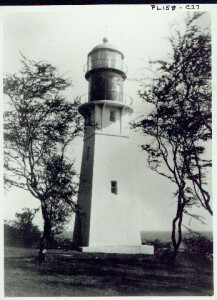 | USA; HAWAII | WRITTEN ON VERSO: BUILT 1899, REBUILT 1917, 55 FEET HIGH. | NOTES: Description: Located at the eastern end of Waikiki Beach, the Diamond Head Crater is a familiar landmark to the throngs of tourists who today pack the high-rise hotels in the area. For mariners of yesteryear, Diamond Head also served as a landmark for their approach to the harbor at Honolulu from the west coast of the United States. In the 1820s, sailors discovered what they believed were diamonds in the rocks on the volcano's slopes. Although the sailor's diamonds turned out to be clear calcite crystals, the name Diamond Head has been associated with the crater ever since. With the increase of commerce calling at the port of Honolulu, a lookout was established in 1878 on the seaward slopes of Diamond Head for spotting and reporting incoming vessels. John Charles Petersen, a mariner born in Sweden, was the first watchman at the station and was paid $50 per month. After his arrival in Hawai`i Petersen married a native girl who died just four months after the birth of their daughter Melika. Diamond Head Charlie raised his daughter at the isolated station where he served for thirty years until his death in 1907. During the night of October 2, 1893 the SS Miowera grounded on the reef just off Diamond Head. As Diamond Head was obscured that evening, the vessel's captain had mistaken the high land to the north of the crater as Diamond Head and had brought his ship too close to shore. All passengers and cargo were safely off-loaded, but it took six weeks to free the Miowera. Four years later, the magnificent steamship China also ran aground. It was widely believed that both of these incidents could have been avoided had a light been shown from Diamond Head. Captain James King, minister of the Interior for the Republic of Hawai`i, had been petitioning the Hawaiian legislature for a light on Diamond Head for several years, and according to the following account from the December 4, 1897 edition of the Pacific Commercial Advertiser steps were finally being taken to rectify the situation. Captain King became weary of hearing the pros and cons of the case, and after a few trips to the vicinity with Mr. Rowell, the Superintendent of Public Works, drove a stake for the site of the beacon. ... There was ordered at once the material for the illumination and for the towers. The iron for the structure has arrived and as soon as some road is made to the slope point, work on the structure will begin. The selected site was just 250 yards west of Charlie's lookout tower, and the original structure was a forty-foot-tall, iron, framework tower built by Honolulu Iron Works. Barbier and Benard of France manufactured the third-order Fresnel lens along with the lantern room for the tower. Due to concerns over the stability of the structure, the open framework was enclosed with walls constructed of coral-rock, excavated from a quarry on O`ahu. The light, which had a red sector to mark dangerous shoals and reefs, was first lit on July 1, 1899. A circular hole was left about midway up the tower so that Diamond Head Charlie could have an unobstructed view towards Barbers Point. John M. Kaukaliu was the first keeper of the Diamond Head Lighthouse, and as no keeper's dwelling was provided, he lived at a private residence about a quarter of a mile from the lighthouse. When the Lighthouse Board took control of all aids to navigation in the Hawaiian Islands in 1904, it reported that the Diamond Head Lighthouse was the only first-class lighthouse in the territory. However, during an inspection in 1916, it was noted that growing cracks in the structure were compromising the tower's integrity. In 1917, funds were allocated for constructing a fifty-five-foot tower of reinforced concrete on the original foundation. Scaffolding was built around the old tower and the original lantern room was removed and placed atop a new metal framework, allowing the continuous operation of the light. The old tower was then dismantled and replaced with the modern concrete structure, which strongly resembles the original tower. One notable difference is that the old tower had an external staircase that wrapped partway around the tower, whereas the new tower houses an internal, cast-iron, spiral stairway. When the tower was complete, the lantern room containing the Fresnel lens was placed atop the new lighthouse. The first keeper's dwelling at the station was built several yards west of the tower in 1921, three years after the new lighthouse was activated. Before that time, the keepers typically lived in a nearby village. A keeper occupied the dwelling for just three years, as the station was automated in 1924. Subsequently, the dwelling became home to Frederick Edgecomb, superintendent of the Nineteenth Lighthouse District. He lived at the lighthouse until 1939, when the Coast Guard assumed control of all lighthouses. During World War II, a Coast Guard radio station was housed in the keeper's dwelling, and a small structure was built on the seaward side of the tower. Following the war, the dwelling was remodeled and has since been home to the Commanders of the Fourteenth Coast Guard District. Rear Admiral Benjamin Engel moved into the dwelling in 1967 with his wife Ruth. The first view of her new home left Mrs. Engel speechless, as she had never lived in such a beautiful location nor had a lighthouse in her yard. The well manicured lawn adjacent to the Diamond Head Lighthouse is a perfect spot for entertaining, and the Engels hosted many a party for friends and visiting dignitaries. Rear Admiral Engel occasionally forgot to inform his wife exactly how many would be in attendance, but one party will never be forgotten by the Engels. During this gathering, Mrs. Engel was amazed at the number of people her husband had invited. While conversing with one of the unfamiliar guests, Mrs. Engel learned that a group of tourists had come to explore the Diamond Head Lighthouse and were simply delighted to discover that the Coast Guard was hosting an open house. Besides continuing its nightly vigil over the reefs at Diamond Head, the lighthouse also serves as one end of the finish line for the biennial Transpac Yacht Race, which starts 2,225 miles away in Long Beach, California. During the race, members of the Transpacific Yacht Club are allowed to use the tower as a lookout for recording finishing times. The road near the lighthouse is packed with people watching the beautiful yachts, under full sail, riding the trade winds towards Honolulu. Even when there isn't a race to watch, the pullouts near the lighthouse offer amazing views of the surf and those who are drawn to ride it. References The Lighthouses of Hawai`i, Love Dean, 1986. | P0001.012/01-#PL158 | |||||
| 9 | 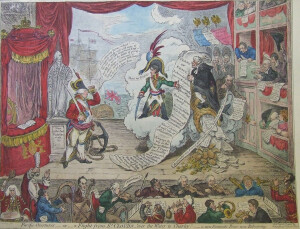 | SHORT DESCRIPTION: [Pulled from identical image at The British Museum] The stage, flanked by the stage-boxes, extends across the design, the base of which is the orchestra, where the new Ministry perform. George III has stepped on to the stage from the royal box (left) and confronts Napoleon, who stands arrogantly upon clouds and points to an enormous scroll held up by Talleyrand. This stretches across the cloud to rest on the stage. The Emperor, in uniform, with spurred jackboots and wearing a large, feathered bicorne, holds a sword in his right. hand and says fiercely: "There's my Term's." The King, who wears uniform with a small cocked hat and buckled shoes, holds his sword against his shoulder. He inspects the scroll through his glass, saying: " - Very amusing Terms indeed! - and might do vastly well with some of the new-made little Gingerbread kings - but WE are not in the habits of giving up either "Ships, or Commerce, or Colonies", merely because little Boney is in a pet to have them!!!" The scroll is inscribed: 'TERMS OF PEACE - Acknowledge me as Emperor - "mantle your Fleet, - Reduce your Army - Abandon Malta & Gibraltar, - Renounce all Continental Connection - Your Colonies I will take at a Valuation, - Engage to pay to the Great-Nation for 7 Years annually £1.000.000. and Pace in my Hands as Hostages the Princess Charlotte of Wales, with Ten of ye late Administration whom I shall name.' Talleyrand kneels on one knee, displaying a deformed left leg, on a cornupia which rests on the clouds that support Napoleon. He wears a long gown with a rosary (denoting the ex-Bishop of Autun); a pen is behind his ear. From the cornucopia papers, money-bags, and coin pour down on to the stage. The papers are: 'Address to the Papists'; 'Loan to the - ['Prince' implied]; 'To the United Irishmen'; 'To the London Corresponding Society'; 'The Press'; 'The Argus'; 'For the Whig Club'; 'To the Army; 'To the Navy', 'To [the] Volunteers'. Money-bags are labelled: 'Maynooth [word illegible]', 'Horne Tooke', 'Morning Chronicle', '[Cobbett's] Weekly Register', 'Thelwall.' Immediately behind Talleyrand, and also on the Napoleonic clouds crouch Arthur O'Connor, looking down conspiratorially at Fox in the orchestra below. His words extend in a long label towards Fox: "Remember m Friend your Oath, - " Our Politicks are the same!"" He holds a paper: 'at Maidstone Not Guilty - N.B - my Confederate Quigley only, was Hanged there.' Behind Talleyrand and O'Connor three desiccated corpses wearing French Grenadier's uniform hold up three eagles to each of which a banner is attached: 'Army of England', 'Army of Ireland', 'Army of Scotland'. Their caps are decorated with an 'N' surmounted by a crown. Behind them bayonets recede in perspective, their holders hidden by the peace scroll. Most of the orchestra sit facing each other at a long desk whose slopes hold their music. At its head (left) sits Grenville, the First Violin, saying "Attention!"; in his pocket is a paper: 'Broad Bottom Concert'; his music is 'Britons Strike Home'. Facing him at the opposite end sits Moira, very erect, blowing a trumpet; his music is 'See the Conquering Hero comes'. Four performers sit on each side; nearest the stage and on Grenville's left, sit (left to right) Fox, with a violin, pausing with extended bow to look up at O'Connor; his music is 'God save the King'. Next him is Lord Spencer, playing a violin, but without music Windham, also playing a violin, his music is 'Cheese Parings'. Next, and on Moira's right, Sheridan, fat and bloated, sleeps with folded arms, clasping a bassoon; his music is 'The Midwatch' [for Sheridan as the sleeping watchman]. The others, facing the stage, turn their heads in profile. Little Lord Henry Petty, on Grenville's right, wearing his Chancellor's gown, plays the triangle; his music is 'the little Jesuits Jig' [he is the son of 'Malagrida'; for 'jig']. Next Sidmouth performs on a clyster-pipe; his music is 'Water-Gruel' . Lauderdale blows the French horn, his music is 'Brissots Delight'. Tierney, self-absorbed, plays two pipes: one inscribed 'Grenville' the other 'Fox'; his music is 'How Happy could I be with either', with another paper headed 'Borough' [he was M.P. for Southwark, and regarded as eager for office under any Government]. The rest of the orchestra are on the left, behind Grenville's back. On the extreme left. Erskine, the egotist, full face, regardless of the others, beats a drum with the mace. Lord Ellenborough stands as if conducting, holding up a rolled document: 'Bill of Indemnity' [the Bill for giving indemnity to witnesses against Melville, it was opposed by Ellenborough,'Parl. Hist.' vi. 248 f.]. Bedford plays the harp: 'Harp of St Patrick'. In his pocket is 'a Serious Ballad Burke to Duke' [Burke's 'Letter to a Noble Lord' was to his brother]. Grey, his music 'Rule Britannia', hanging over the back of Grenville's chair, plays the 'cello. The royal box is sumptuously draped, and surmounted with a crown and crossed sceptres, with the inscription: 'Ge IIId | whom God long preserve'. Behind his empty chair is the pompously projecting stomach with Garter ribbon, and hand holding the wand of the Lord Chamberlain, Lord Dartmouth. On the front of the box lies an open book: 'Shakespeare - I know You all.' Next the box and immediately behind the King is a lifelike statue of Pitt, wearing (like Petty) the gown of the Chancellor of the Exchequer. One hand rests on a pillar inscribed 'Integrity'. The high pedestal is inscribed 'Non sibi sed Patriae vixit' [the motto on the badges of the Pitt Clubs which came into existence on Pitt's death. Broadley, i. 242]. Beside the King is an anchor and rope. At the back of the stage, behind the King, is the sea with a man-of-war in full sail: 'The Royal Sovereign'. On the r. are four stage-boxes. On the level of the stage the Prince and Mrs. Fitzherbert sit gazing at each other; he holds his cocked hat, she has a fan with the Prince's feathers and holds a playbill: 'Shortly will be Perform'd the Farce Dolly made a Dutchess.' In the box immediately above are Horne Tooke (in clerical dress) and his friend Burdett, holding up his cocked hat. Both applaud vigorously, saying respectively 'Bravissimo!' and 'Bravo'; they look towards Talleyrand and Napoleon. The former's playbill is 'Duet on a Pair of Portraits', the latter's 'The Brentford Bully, a new Song - Liberty and Equality down with all the Prisons'. Over this box are the Prince's feathers. Next it, and above the door leading to the stage, is a small box from which Grattan leans delightedly, his playbill is 'Irish-Jig - Report of the secret Committee - Neilson told me he had Sworn Mr Grattan.' Above Grattan, in a small box at the upper edge of the design, are the Duke of Clarence and Mrs. Jordan, both grossly caricatured. Their playbill is 'Jobson & Nell' [the cobbler and his wife in 'The Devil to Pay']. 5 April 1806 Curator's comments: (Description and comment from M.Dorothy George, 'Catalogue of Political and Personal Satires in the British Museum', VIII, 1947) The Ministry's peace overtures (which began in March, and continued after Fox's death on 13 Sept.) are associated with Jacobinism, sedition, and treason, and especially with Franco-Irish intrigue and the relations between Fox and O'Connor. Fox's evidence at Maidstone (May 1798) was: 'I always thought Mr O'Connor . . . attached to the principles and the constitution of this country, upon which the present family sit upon the throne, and to which we owe all our liberties'. O'Connor (whom Fox met in France) at this time was a general in the French service. For 'The Press', organ of the United Irishmen; for 'The Argus', a propagandist paper in English, printed in Paris, see BMSat 9998. Napoleon is charged with financing English and Irish Jacobins, and even the anti-Pittite Press, i.e. the 'Morning Chronicle' and 'Cobbett's Political Register', though Cobbett had maintained the dangers of a popular demand for peace, and recently asserted that a tolerable peace was unattainable 'until we have a real army'. 'Pol. Reg.', 8 Feb. (ix. 167). The allusion to Maynooth is obscure, and is probably due to Gillray's hatred of 'Popery'. The seminary was founded in 1795 by an Act of the Irish Parliament: the first move towards an additional grant was a suggestion by Petty to Grenville, 25 Apr. 1806 ('H.M.C., Dropmore MSS.' viii. 120 f.), not carried out till after Fox's death. The divisions in the new Ministry, &c, are suggested by each man's absorption in a separate tune. There is a second state, the Prince of Wales altered to Lord Derby, it is said on account of the offence given to the King by the Prince's association with Mrs. Fitzherbert. The play-bill is altered to: 'the Farce Darby a Duke & Joan a Duchess'. This state was reprinted in 1830 and 1851. Grego, 'Gillray', p. 330 f. (reproduction). Wright and Evans, No. 314. Reprinted, 'G.W.G.', 1830. Broadley, i. 241 f. Reproduced, Grand-Carteret, 'Napoléon', No. 163. | CL16343 | |||||||
| 10 | 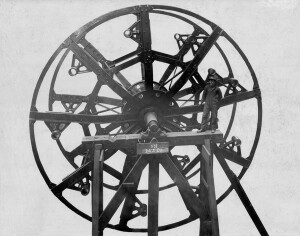 | After 1936 | Worker posed on wheel for scale. The SS Tashmoo and her date with doom. By Don Lochbiler-February 7, 2000. Still, she was a proud and luxurious ship. For decades she was the best-loved vessel on the Detroit River. Her fame was so great that most Detroiters came to think Tashmoo Park was named after the boat, instead of vice versa. Tashmoo Park was the pleasure spot set in the pleasant greenery of the St. Clair Flats (in the area of Harsens Island), where the steamer Tashmoo stopped several times daily on trips between Detroit and Port Huron. When the park opened in 1897 it was regarded as the crowning touch that gave Detroit as fine a summer playground as any city on the lakes could boast. Besides its stately groves of old trees with plenty of picnic tables, a baseball diamond, swings and rides, the park had a casino and a dancing pavilion so big everybody goggled. It had real Indians too. They paddled over from the Canadian reservation on nearby Walpole Island and sold moccasins and beadwork to fun seekers from Detroit. Developed by the Star-Cole Line, the park was delightful for one-day family excursions on the steamer Darius Cole or the big new Greyhound. At 50 cents a round trip, it was a real bargain. A reporter for The Detroit News-Tribune took the trip and was enthusiastic about what he found: "One's first trip to the Flats is a red-letter day in life's calendar. This western Venice seems to be a spot where tired feet and dusty pavements are no more, but where the people float through liquid streets." Since establishment of the Lake St. Clair Fishing and Shooting Club in l872 later to become the Old Club private clubs, cottages and hotels proliferated at the Flats. Tashmoo Park broadened the resort's popularity base to include virtually all Detroiters. The hotels ran a wide gamut. At Joe Bedore's, six-bottle men always could be sure of lusty companions. At the other end of the scale, the Island House offered rustic charm to many families from the South who came year after year to escape the heat back home. The dignified Muir House, operated by Mrs. C. M. Muir, was advertised as "the only temperance house at the Flats." In 1897, the newest and most pretentious hostelry was Riverside Hotel, a mile beyond Star Island. It attracted admiration for its fine expanse of lawn between the main building and the dock. Under rainbow-hued parasols, women guests paraded on the lawn and verandas to watch the passing show of Great Lakes vessels threading the channel hardly a fair-sized croquet stroke away. Ore and grain freighters were numerous, but the big attractions were the cruise ships for the Upper Lakes. Waving passengers thronged their decks. The Detroit & Cleveland Navigation Co.'s new steamer, the City of Mackinac, took cruisers to Mackinac Island from Detroit at $12.50 for the round trip, meals and berth included. The Detroit, Windsor & Soo Line offered a seven-day trip to Georgian Bay and Lake Superior for $l7. The aristocrat of cruise ships, the Canadian Pacific's Alberta, charged $20 for a journey to Fort William, Ontario The most welcome sight of all for ship-watchers at the Flats, however, was the Tashmoo. The schedule she maintained through the resort area seemed incredible. In less than an hour, the Tashmoo made 10 stops. What words can recapture the excitement of a Tashmoo landing? The seemingly reckless approach to the dock; the spouting foam of the reversed paddlewheels bringing her to a sudden halt; the shouted greetings across the narrowing span between ship and shore; the clanging bells. Swiftly followed the accurately tossed hawser loops dropping on the piles, the gangplank lowered and the passengers hurrying off while the never-stilled engines throbbed impatiently. Within seconds the rising gangplank nipped at the heels of any dawdling passenger. Retracted hawsers whistled through the air; bells clanged again; more spouts of foam. Then the fluttering handkerchiefs of farewell dwindled behind. Only the Tashmoo could do it with such flair. She had her trial run in 1900. Adm. George Dewey and his bride were among her first passengers. Her epic race with the City of Erie and President Theodore Roosevelt's ride on her soon after he became President added to her eclat. But on Dec. 8, 1927, the doubts the old rivermen expressed for so long about the steamer came to the fore. That was the day the Tashmoo, in the worst storm on the river in years, disappeared without a soul on board. A 60-mile-an-hour gale was blowing, driving snow before it. During the night the temperature dropped 40 degrees, to 8 above. In the predawn blizzard The Detroit News dispatched a reporter and photographer to assess storm damage along the waterfront. At the office of the White Star Line, sucessors to Star-Cole, at the foot of Griswold, the team for the paper found the big story in the person of a white-faced watchman, Robert McCrumb. McCrumb waved at the dock where for many weeks the Tashmoo was moored at winter anchorage, made secure by 14 heavy steel cables. "She's gone," he said. "Gone right up the river." McCrumb remained at his post while the storm mounted. "Then the cable started snapping," he said. "They went one after the other, like they were grocery string." McCrumb heard a crash, muffled by the wind, moments after the Tashmoo broke loose. On this tip the newsmen pushed their way a block east, to the Woodward Avenue dock of the Detroit and Windsor Ferry Co. What the Tashmoo hit, they learned, was the ferry Promise. Anton Mensen, her engineer, and three crewmen leaped to the dock after the impact. They were getting up steam for the ferry's first morning run across the river. "Just like she was starting on her regular summer run up to Port Huron," a crewman volunteered. Taking off in their vintage Model T roadster, equipped with isinglass side-curtains, the searchers made their next inquiry at the foot of Randolph, home base for the fireboat James Battle. Had anyone seen the Tashmoo heading upstream? "No, and we haven't seen the Flying Dutchman, either," answered a skeptical fireman. When further explanation convinced him that he was not being ribbed, he offered a suggestion: "There's only one thing can stop that fool boat," he said. "The Belle Isle Bridge." Visibility was near zero when the Model T reached the bridge, but long before the searchers sighted the Tashmoo they could hear the anguished banging of the ship against the concrete abutment. And then, there she was listing tipsily to port, her sides gashed, but still seemingly determined to batter her way up to Lake St. Clair. Two tugs arrived, and after a struggle to get lines aboard, they pulled the Tashmoo away from the bridge. In tandem formation, they tried to tow her to the Detroit Shipbuilding Co. dock at the foot of Orleans, where she was built. Still she wasn't subdued. Abeam of the Walkerville ferry dock at the foot of Jos. Campau, the Tashmoo snapped the hawser and once again plunged upstream toward the bridge. She was only 10 yards from it when the tugs got lines on her once more. This time she followed them to harbor. Repaired and refurbished, the Tashmoo lived on for nine more years until the sad night of June 18, 1936. She was chartered for a moonlight ride that evening by the Pals Club, a Hamtramck social group. A crowd of 1,400 gathered at the foot of Griswold. River traffic delayed the Tashmoo's return from her day trip, one of the cut-rate Friday excursions to Port Huron sponsored by the News. She left dock at 9:20 p.m., 20 minutes after her longtime rival in the moonlight trade, the Columbia, was speeding downriver. The Tashmoo made up most of the deficit. She reached Sugar Island, near Grosse Ile, at l0:35 p.m., and started on the cruise homeward at ll:20. As she came out of Sugar Island Channel a shock was felt throughout the ship. Passengers were told that there was engine trouble. Jean Calloway's orchestra played on, and the dancing never was more lively. But in the engine room it was different. The Tashmoo had struck a submerged rock. The wound was mortal. As water poured in through a hole in the hull faster than the pumps could handle it, the engine room crew stoked the boiler fire in a swirling, waist-deep flood. Capt. Donald MacAlpine called for full speed ahead. Ten minutes after the shock, the Tashmoo docked at the Brunner-Mond Co. coal wharf above Amherstburg on the Canadian side. Only after passengers and crew were safely ashore did the grand old steamer sink to the bottom in 18 feet of water. The Tashmoo's days of glory were over. The SS Tashmoo lies partly submerged after striking a rock and ripping her hull open off Amherstburg on June 18, 1936. | P0001.004/01-#PC62 |
Created 2026 by Don Barker, CBMM volunteer, for the Chesapeake Shipbuilding Project. shipbuilding@sailingworkboats.es